Monday, November 28, 2011

The Global Economic Crisis and the Challenge of Reforming Banking and Finance Practice


As world economic leaders convene at the 40th World Economic Forum in Davos, Switzerland (DAVOS 2010), polls have shown that fears are mounting among business leaders being increasingly fearful of over-regulation by Governments. How to get out of the global economic crisis is key on the agenda but the concern for business owners particularly owners of financial institutions is how the outcome of their deliberations can affect the competitiveness of their actual and potential investments.
The general trend of responses by Governments to the global financial crisis is a tightening of regulatory freedoms for industry operators. In Nigeria for instance, more regulation has resulted in the Central Bank of Nigeria placing a straight 10-year ceiling on the maximum number of years an individual can serve as a Chief Executive Officer of financial institutions. This is in addition to stricter financial reporting obligations, the introduction of the common year-end policy coupled with the adoption of International Financial Reporting Standards (IFRS), amongst others.
It is expected that the call for thorough banking reforms will be a key agenda at the DAVOS 2010 Forum. As world economic leaders and their Governments debate the thoroughness of the proposed banking reforms, attention should be paid to their implementation in a way and manner that does not lead to Government over-regulation.
Business owners in all sectors of an economy, particularly owners of financial institutions have a genuine fear of industry over-regulation. This is because over-regulation can drastically alter the balance of competition that is so central to service delivery and consequently corporate and industry recovery. The modus operandi of the financial regulator is critical to the restoration of industry confidence both from the client and industry investor points of view. With the introduction of sound policies and practices, the industry will in no time be back on the path of growth and stability.
What may be termed over-regulation of the financial industry is at best relative. This will depend on the peculiar circumstances of the financial industry in each nation. The level of operational sophistication of the regulator and the operator are key determinants. As fears of over-regulation have become a global issue, it is important to note that what may be termed over-regulation in one country may be regarded as under-regulation in another. The industry structure, established systems, level of sophistication, historical antecedents and industry peculiarities are key factors to consider whether a policy initiative by the financial regulator is deemed to be over-regulating.
The unprecedented failure of financial institutions in developed economies has given credence to the argument that financial self-regulation is itself not entirely effective in dealing with the sort of economic crisis the world faces today. There is absolutely no doubt that some form of stiffer Government regulation is required. However, Government regulation should strive to strike a balance between maintaining depositor confidence as well as maintaining investor confidence in the industry. This is because over-regulation poses a serious risk to investor confidence.
The present global economic crisis has highlighted some of the weaknesses inherent in the purely pro-capitalist system of economic management. The free market economic system while being effective in the allocation of some scarce resources cannot effectively cater for some basic human elements such as fear of the unknown, greed and ambition. Some of these elements are prime motivators for individuals who are saddled with the responsibility of taking economic decisions on behalf of their financial institutions and Governments.
The bottom-line is that Banking and Finance reforms regulation need to be comprehensively focused and specialized so that the financial regulator can closely and constantly monitor the performances of financial operators. With such an approach, individual institutions or groups whose performances deviate from the norm can be quickly and accurately corrected. To this end, proactive strategies of regulation can be developed to preempt likely undesirable tendencies while reactive strategies can be implemented to deal with actual deviations from the norm. In line with the above, firm Government regulation is likely to be the popular clarion call for a long time to come.

Role of Central Banks in a Less and More Developed Economy


In developed nations, central banks conduct a wide range of banking, regulatory, and supervisory functions. They have substantial public responsibilities and a broad array of executive powers. Their major activities can be grouped into five general functions:
(1) Issuer of currency and manager of foreign reserves: Central banks print money, distribute notes and coins, intervene in foreign-exchange markets to regulate the national currency's rate of exchange with other currencies, and manage foreign-asset reserves to maintain the external value of the national currency.
(2) Banker to the government: Central banks provide bank deposit and borrowing facilities to the government while simultaneously acting as the government's fiscal agent and underwriter.
(3) Banker to domestic commercial banks: Central banks also provide bank deposit and borrowing facilities to commercial banks and act as a lender of last resort to financially troubled commercial banks.
(4) Regulator of domestic financial institutions: Central banks ensure that commercial banks and other financial institutions conduct their business prudently and in accordance with relevant laws and regulations. They also monitor reserve ratio requirements and supervise the conduct of local and regional banks.
(5) Operator of monetary and credit policy: Central banks attempt to manipulate monetary and credit policy instruments (the domestic money supply, the discount rate, the foreign-exchange rate, commercial bank reserve ratio requirements, etc.) to achieve major macroeconomic objectives such as controlling inflation, promoting investment, or regulating international currency movements. Sometimes these functions are handled by separate regulatory bodies.
Central banks are capable of effectively carrying out their wide range of administrative and regulatory functions in developed nations primarily because these countries have a highly integrated, complex economy; a sophisticated and mature financial system; and a highly educated, well-trained, and well-informed population. In developing countries, the situation is quite different. LDCs may be dominated by a narrow range of exports accompanied by a much larger diversity of imports, the relative prices (the terms of trade) of which are likely to be beyond local control. Their financial systems tend to be rudimentary and characterized by:
(1) foreign-owned commercial banks that mostly finance domestic and export industries.
(2) An informal and often exploitative credit network serving the bulk of the rural and informal urban economy.
(3) A central banking institution that may have been inherited from colonial rulers or operates either as a currency board issuing domestic currency for foreign exchange at fixed rates or simply to finance budget deficits.
(4) A money supply that is difficult to measure (because of currency substitution) and more difficult to regulate.
(5) An unskilled and inexperienced workforce unfamiliar with the many complexities of domestic and international finance.
(6) A degree of political influence and control by the central government (over interest rates, foreign-exchange rates, import licenses, etc.) not usually found in more developed nations.
Under such circumstances, the principal task of a central bank is to instill a sense of confidence among local citizens and foreign trading partners in the credibility of the local currency as a viable and stable unit of account and in the prudence and responsibility of the domestic financial system. Unfortunately, many LDC central banks have limited control over the credibility of their currencies because fiscal policy - and large fiscal deficits - call the tune and must be financed either by printing money or through foreign or domestic borrowing. In either case, prolonged deficits inevitably lead to inflation and a loss of confidence in the currency.
Given the substantial differences in economic structure and financial sophistication between rich and poor nations, central banks in most of the least developed countries simply do not possess the flexibility or the independence to undertake the range of monetary macroeconomic and regulatory functions performed by their developed-country counterparts.

India Interest Rates: Banking and Economic Growth


The benchmark interest rate in India, as reported in the beginning of 2011, is 5.5%. During 2000-2010, the average Indian interest rate was 5.82%, reaching the historical high mark of 14.5% in August 2000 and a record low of 3.25% in April 2009.
In India, the Reserve Bank of India (RBI) takes all the decisions on interest rates. Recently, the RBI has urged banks to raise their deposit rates in order to attract more investors. The reason for this step is that credit growth is already in good shape in India, while deposit growth is still to catch up. Following this, Kotak Mahindra Bank has offered its highest ever rate of 9.25% on deposits for 700 days.
Banks in India
India is considered the 'most regulated' banking sector globally, with more than 170 banks in the urban, semi-urban and rural areas. Many banks remained tough even during the worst ever global recession of 2008. Here are India's top 10 banks with high interest rates, as ranked by Business Review India:
  • State Bank of India (SBI)
  • ICICI
  • HDFC
  • Allahabad bank
  • The Bank of Baroda
  • Punjab National Bank
  • Canara Bank
  • Axis Bank
  • Union Bank of India
  • IDBI
  • Kotak bank
The Indian banking industry is sufficiently funded and synchronized. Although the share market has dipped to half its value within one year, the nation's banking sector has declared a profit rise of 40%. SBI features in the list of 500 prominent companies in the world, and this has strengthened the trust of investors as well as the FDIs. This achievement, along with the direct support of the Indian government, has contributed to its high interest rates.
Economic growth in India
According to the data released by India's Central Bureau of Statistics, India's GDP grew 8.8% in the second quarter of 2008. Its information technology industry has attracted many investors, leading to this industry becoming highly focused. Additionally, the series of related back-up policies executed by the Indian government has also advanced economic growth.
A lot of issues still need to be addressed if we are to achieve the status of a 'sound economy', such as inflation control, increase in employment opportunities and equal wealth distribution. Interest and deposit rates are expected to remain high going forward, and 2011 is likely to be a profitable year from the perspective of the common man.

Quantum Economics - Philosophy of the Economy - Central Banking System Policies


A central banking system allowed issuing of capital and underwriting of low interest rate loans to countries around the world is possible in the new economic environment of Market Globalization, Great Capitalization and Rising Productivity when all these new developments are capitalized by the most developed countries by imposing new economic regulations and requirements to the rest of the world to enhance the less developed and developing markets' "security" and make these "markets" play under the same rules, but first, these financial, business and other economic regulations must be implemented by the most developed countries and markets themselves (as explained in Quantum Economics-Philosophy of the Economy's articles). The central bank lending system is to finance not just less developed and developing countries and markets but also any market which present projects complying with the general policies of Global development such as environmental protection, renewable energies, etc.
World Bank, IMF and WTO as we all know well exist and do what they are thought and tell to do: lend on high interest rates over tight deficit, social expenses and infrastructural matrix; these kinds of policies were well justified by:
  • First, political division in a Cold war World, isolation and political struggles, remoteness and socialization created sometimes great instability and interruptions of international relations to the extend of disrupting paybacks of international loans.
  • Second, closed and independent market structures such as the Communist of Eastern Block countries and China, or the constantly changing market structures of South America, Asia and Africa shifting left or right provoked constant inflations and other economics turbulences as many of these less developed and undeveloped markets had very diverse system of economics consequently effected the needed "security" for the lending institutions therefore the interest rates were to be set high enough to offset the estimated risk.
  • Third, low productivity and market remoteness could bring to a less developed or undeveloped country a "quick" turn to a recession if financial discipline is not followed
Which new economic developments in the world are making low rates lending possible?
Obviously, the ongoing market globalization and rising productivity are setting a prejudice in the ways of global development where new possibilities of central bank financing with "controlled" deficit matrix and "very low" interest rates are possible to be the new economic tools for such global development that could allow "quantum" leaps from underdevelopment onto high tech environmentally friendly development; The new "Quantum Economics-Philosophy of the Economy" is not only "production" related (tighten to) as the Marx's systems are but it (Quantum Economics-Philosophy of the Economy" is related (tighten to) the equity of (limited and controlled deficit) social and infrastructural expenses, the return on the invested capital and the value of intellectual properties.
What is "quantum leap" in "Quantum Economics-Philosophy of the Economy?"
Quantum leap is a possible jump in economic development based on "artificial (externally)" financed projects for practically financing and loan servicing environmentally friendly projects on a Global scale. Quantum leap is financed by a capital issuing central banking system more like the World Bank and IMF on a very low interest rate, because of the enhanced "security" in a new Global marketplace. This financing is done and promoted through private commercial banks on very low margin and set matrix.

Economic Indicators of a Healthy Banking Industry


Do you have savings in banks? Are you afraid that your bank will become bankrupt or insolvent due to economic crisis? With the current economic state, it is just normal to worry about the financial standing of banks due to the prevalence of bank closures and bankruptcies nowadays.
Did you know that the global economic crisis that took place between 2008 and 2009 not only affect ordinary individuals, small and medium businesses, financial institutions and organizations, but also small and big banks worldwide. The dire economic situation resulted to massive dismissal of employees, shutdown of industrial factories, closure of stores and filing of bankruptcies not only for individuals, but also business enterprises.
Because of these scenarios, investors are afraid to put up their investments, while some people, like you, are afraid to save their money on banks. To avoid risking your money on unhealthy companies, you should assess their financial performance and evaluate signs of unhealthiness.
Instead of depending on press releases and advertisements, it is best to conduct research yourself. With the cornucopia of information found on the web, use the Internet to conduct an unbiased investment analysis of the bank or company that you intend to put on investment.
Signs of a healthy bank or organization:
  • Healthy companies have increasing or higher profit margins on operations than the average set by the industry.
  • These companies have excess cash flow.
  • These firms managed to have earnings growth despite the onset of recession.
  • These banks by reasonable price-to-earnings ratio (P/E) and their P/E should not be greater than 25% of their stock earnings growth rate.
Other signs of a healthy bank or organization:
  • Management and employees have one focused mission.
  • Healthy companies have pervasive service attitude focused on the needs of customers.
  • These companies have faith in their ability to win, to profit and to prevail.
  • They are committed in boosting the health and well-being of their employees.
  • They offer employees opportunities for career development and further learning.
  • They show commitment for corporate social responsibility.
  • These firms have diverse product lines and diverse type of customers.
  • Healthy companies have low level of employees' complaints, fightings and power struggles. Workers in healthy firms are willing to jump to other departments to help out.
  • Healthy working environment has a two-way communication and management values employees as its intangible assets.
  • Top management show supportive supervision to their workers and employee participation are practiced and highly encouraged.
  • These companies offer workers opportunities to learn things and gives priority to work-life balance.
  • Ways to determine the financial standing of a bank before opening an account:
  • Check news reports of the bank where you consider opening an account.
  • Inquire from the FDIC on the general financial status of the company.
  • Select banks that have improving ratings for several quarters and managed to maintain their ratings despite the onset of recession.

Privacy Policy

Privacy Policy for http://economicbankings.blogspot.com/

If you require any more information or have any questions about our privacy policy, please feel free to contact us by email at adesekar07@gmail.com.

At http://economicbankings.blogspot.com/, the privacy of our visitors is of extreme importance to us. This privacy policy document outlines the types of personal information is received and collected by http://economicbankings.blogspot.com/ and how it is used.

Log Files
Like many other Web sites, http://economicbankings.blogspot.com/ makes use of log files. The information inside the log files includes internet protocol ( IP ) addresses, type of browser, Internet Service Provider ( ISP ), date/time stamp, referring/exit pages, and number of clicks to analyze trends, administer the site, track user’s movement around the site, and gather demographic information. IP addresses, and other such information are not linked to any information that is personally identifiable.

Cookies and Web Beacons
http://economicbankings.blogspot.com/ does use cookies to store information about visitors preferences, record user-specific information on which pages the user access or visit, customize Web page content based on visitors browser type or other information that the visitor sends via their browser.

DoubleClick DART Cookie
.:: Google, as a third party vendor, uses cookies to serve ads on http://economicbankings.blogspot.com/.
.:: Google's use of the DART cookie enables it to serve ads to users based on their visit to http://economicbankings.blogspot.com/ and other sites on the Internet.
.:: Users may opt out of the use of the DART cookie by visiting the Google ad and content network privacy policy at the following URL - http://www.google.com/privacy_ads.html

Some of our advertising partners may use cookies and web beacons on our site. Our advertising partners include ....
Google Adsense


These third-party ad servers or ad networks use technology to the advertisements and links that appear on http://economicbankings.blogspot.com/ send directly to your browsers. They automatically receive your IP address when this occurs. Other technologies ( such as cookies, JavaScript, or Web Beacons ) may also be used by the third-party ad networks to measure the effectiveness of their advertisements and / or to personalize the advertising content that you see.

http://economicbankings.blogspot.com/ has no access to or control over these cookies that are used by third-party advertisers.

You should consult the respective privacy policies of these third-party ad servers for more detailed information on their practices as well as for instructions about how to opt-out of certain practices. http://economicbankings.blogspot.com/'s privacy policy does not apply to, and we cannot control the activities of, such other advertisers or web sites.

If you wish to disable cookies, you may do so through your individual browser options. More detailed information about cookie management with specific web browsers can be found at the browsers' respective websites.

Thursday, October 13, 2011

POLITICAL ECONOMIC BRINKMANSHIP

After a sojourn to reflect and refocus on developments, what are the questions that dominate the political ether? The question I hear most often socially: "is the government (US or UK) doing the right thing?" My answer is a confident YES. Then I say "but both US and UK governments are failing to paint a clear picture of what they are doing and precisely why!"
see also: http://lloydsbankgroup.blogspot.com/)
Republicans in the USA and Conservatives in the UK are successfully twisting the issues to make recession and banking crisis appear domestic political failures. This is most telling for the UK's Labour government with a general election due in less than a year from now. But it has to be clear to intelligent observers that the UK's position is only to be expected and remains prudentially sensible as a proportionate set of responses to the crisis. PM Gordon Brown has maintained a stance that in effect says "trust me (us) to do the right thing to get us out of this crisis." The general public, at least the political chattering class, wants detailed explanations, not abstract assurances. The Conservative Opposition, echoed by the Liberals, have in the media created the axiomatic assumption that "public finances are in a mess." There is tremendous anger about banks and bankers, but the effect of ya-boo politics has been to divert anxious blame onto the government. Reading UK media the impression is gained that the UK's public finances and national debt must be the world's worst, if even no-one is quite sure what precisely defines concepts like 'finances in a mess'. Note the example of the following table. This reviews the financial debt of countries relative to GDP. There is a misnomer in the 3rd column (private sector debt) which is really household debt only as may be surmised in any case from column 7 of total bank assets (total loan gross exposures, not domestic only) given that public sector element is typically about half ratio to GDP with a few exceptions. There is a concerted forgetting that UK private sector gross debt over the past decade grew from 3 times public sector debt to 6 times public sector debt (3 times GDP) while, until the crisis broke, public sector debt held steady and fell slightly. Now the general public are being daily made anxious about the government fiscal deficit and medium term prospect of tax rate rises, most recently by the NIESR report on the economy, which fails to take account of the feedback effects of saving the financial sector. see the following: http://www.niesr.ac.uk/pdf/210709_225037.pdf
The NIESR has adapted the average recovery for previous recessions to state that incomes will not recover to the pre-crisis level (in real terms before unemployment rose and GDP experienced negative quarterly growth) until after 6 years. This is merely the average peak-to-peak period but has been exaggerated in the media as if a damning indictment of someone or something, similarly that GDP rates forecast are worse than the last published government figures (March Budget)? Yet, in fact there is nothing shocking or surprising about this. What is surprising is the NIESR's assumption that with a lower pound growth recovery will be export-led i.e. a total reversal of the credit boom growth previously! This assumption is conditional on whether government efforts to persuade or force banks to maintain or even increase lending will be effective, especially via the public sector owned banks. A very similar view would apply in the USA. What seems remarkably gauche about this outlook is that both UK and USA remain magnets for other countries foreign exchange surpluses. There is an improvement in growth expected for both insofar as the external account trade deficits will narrow as export-surpluses countries trade surpluses shrink, but this is not a recipe for halting unemployment rises. That depends on fiscal boosts and the banks cushioning the shrinkage of credit (deleveraging by banks to thereby most easily restore their capital ratios and by borrowers, especially households, cutting back their spending). Only restoring some credit boom effect and regaining confidence will slow and halt the domino, knock-on, rippling, or however anyone wants to describe it, negative vortex of beggar-my-neighbour impacts through the economy and all economies.
The banks have not woken up and smelled the coffee of their collective responsibility for economic recovery alongside government; they continue to live with pre-crisis mindsets, witness their inability and extreme unwillingness anyway, to tackle the bonus-culture. Government (UK and USA) have also not spelled out clearly enough what the banks are obliged by government to do to help both themselves and the economy. Lloyds Banking Group, for example, has improved its capital ratio to over 14% but mainly by reducing its risk weighted assets (loans) by nearly 40%, of which half was gained by an asset for BoE cheque swap with the Bank of England! The remaining half of the deleveraging is largely by retiring loans and not rolling them over. The effect of this alone in the case of but one bank has a 1% negative ratio to GDP and a GDP impact of possible minus 0.5%. Compounded by deleveraging by other major banks and we have a negative pro-cyclicality effect, precisely what banking regulation Basel II is most concerned to identify and avoid! Is the government forecasting or that of NIESR or any other model supposed to have predicted this? Governments created something of a cleft stick here, on the one hand wanting to see their financial interventions repaid soonest and on the other seeking assurances that the banks would maintain substantially more than minimum regulatory capital reserves and also maintain lending at pre-crisis levels. These objectives if not sensibly timed become mutually exclusive!
It is not hard therefore to conclude that what is less important right now is what caused the crisis and more important is what are the banks doing today? They are making the recession deeper. Bankers have an ready culprit they can blame for causing pro-cyclicality, the Basel II capital adequacy regulations, which ironically were designed with the objjective of addressing precisely this problem!
The banks still look at the underlying economy as exogenous to their business performance, not as something intrinsic that they can directly effect. They have as yet not embraced and understood Basel II Pillar II stress testing and economic scenario analysis and the central banks, government, and economic institutes like NIESR are not offering guidance and tools for how to analyse better the role of banks in the economy!
The banks are currently in a period of retrenchment, recoiling like scalded cats in the face of public sarcasm, and therefore unable to take responsibility alongside government in concerted efforts to redeem the economy. The public debate continues to confuse symptoms and underlying disease. The banking crisis may have had viral-like causes that transmitted throughout the whole financial system, but the public, led by politicians, media and pundits, continue to primarily blame all major banks as if they are individually guilty or heinous excessive risk-taking, even though the collective guilt is also obvious. Some pundits say we should have let individual banks fail absolutely as if diseased parts of the body-financial could be cut out to let the healthy parts prosper. This is myopic at best and ego-mania at worst, every cloud has silver linings for some whether short-sellers or doom-monger talking-heads.
Of course, what is it I'm saying here other than we need more comprehensive clarity delivered to the general public. How easy is that? Not easy at all. Opinions like politics are a market-place. After 2 years of the most intensive news coverage given to any crisis including war coverage, is the general public more attuned to detailed technicalities of what is happening and why, and what is being done, and what should be done, than before? Where can the public plant its feet and say this is real?
Timothy Geithner recently visited Alistair Darling but they failed to use the meeting adequately. They, both of their governments administration, need each other to validate each other's fiscal responses to the recession and financial interventions to salve the banking crisis. But, it is clear they don't quite get that. No one trusts bankers and only reluctantly trust economists. Politicians are generally mistrusted. Therefore this only leaves the inter-governmental sphere where mutual validation and confidence may be gained. My perception is that there is considerable confidence at this level, but it is not being communicated. In part this is because it lacks the tools for the job to analyse policy interventions sufficiently to know the timing of when to expect the positive benefits of policy measures to become apparent, by which I mean both finance sector interventions and budget fiscal deficits. The US and the UK are in recessions that are 6 and 4 quarters ahead of others, and consequently their fiscal deficits are higher and broadly in agreement. Politicians are sensibly wary of creating hostages to fortune, however, in making economic projections of qhen their actions should have positive results. This was a similar problem for central banks when trying to issue warnings ahead of the credit crunch, too wishy-washy elegantly shredded into lumpy bit kind of advice, with on the one hand and on the other etc. If there is one experience to be warned about I gained working in banks and as an economist is that too many people in key risk management positions are more risk adverse about their own careers than capable of setting this aside to state clearly what they believe. That said, it is doubtful that any major bank's board had it received cogent and accurate advice in say 2006 or early 2007 mapping out precisely what was about to hit them, would not have had 'shot' the bringer of bad tidings, at best had him or her dragged off to the funny farm. Economics is for various reasons, including bonus culture ones, something that most top bankers resist like the plague, whether qualified in banking or as is equally commonplace not educated about the totality of banking at all. Economics is sobering and not what inebriates can tolerate if given the choice? Perhaps polticians and central banks should take a leaf out of how wartime leaders such as Roosevelt and Churchill dealt with matters of public information and military command when they recognised that confidence mattered most combined with well-judged honesty in appealing to all to do their utmost in these difficult challenging times, etc? The recession and financial crisis is not a place for simply saying "I am your leader so trust me!" Time for more political courage, to step up and say that to the best of our judgment this is what we believe and deliver confidence-boosting expectations and take the political risk. The opposition political parties similarly need to be seen to stop playing party politics on the issue of getting out of recession and the credit crunch crisis. There are plenty of other matters they can be sarcastic about. Obama attempted in the US to gain a bi-partisan approach on the crises. he only half succeeded. In Europe, it seems to me that bi-partisanship has not even been proposed as a necessary or useful way forward! In the UK, Labour is pinning its hopes on being seen to have steered the economy through the recession. That has no precedents as a political strategy that I can recall. Better would be to simply go for honest statesmanship in the interests of what works best to restore public confidence in what it is that politicians are supposed to do best and most responsibly?
Geithner stated on 13th July that there is a good chance that the U.S. and other leading economies will start growing again over the next two quarters, but there are still significant risks to the outlook. This chimes with UK views (Government and NIESR) that there will be positive GDP growth in 4th quarter 2009. Essentially, this is based on narrowing of the external account and past recessions given that UK and US have both now reached the end of previous average recession periods, with one overlooked aspect that is that UK recovery tends to occur 2 quarters after the US, hence do not expect UK positive GDP before next year! Furthermore, both the official assurances of UK and US governments have been made without analysis of the cycle impacts of what the banks are doing. Their respective national economic models lack that depth; they cannot model for the details of the financial sector statistics within their GDP forecasting models!
Geithner said, "In my view there are still significant risks and challenges ahead," Geithner said when asked if he was concerned about the possibility of a double-dip recession. The issue is less double-dip in my view than simply 'double' given that the financial crisis is doubling the depth of what would have been a more normal to-be-expected recession. He said the world's major economies were largely in agreement on the steps that needed to be taken to boost economic activity. Yes indeed, but hard to guess that from statements by politicians except when speaking under the G8 and G20 umbrella. "I think we have remarkably strong consensus in place on core elements," Geithner said. This is not strictly true on the face of data, but is as good as it gets. He was speaking after talks with UK's Alistair Darling as part of a trip that will take in the Middle East and Paris. Geithner and Darling said leaders of industrialised nations would discuss the measures they are taking when the G20 meets in Pittsburgh in September. This is a critical month for the USA when its annual government budget ends and a new one has to be announced and voted through Congress. The number of state interventions in the banking crisis has slowed compared to last year. Everyone is treading water waiting to see what happens to banks balances by the end of the second quarter to then gauge what the US especially will decide it needs as a fiscal boost after September and in off-budget fiat (money market) interventions and command economy edicts to the banks. By then we should also have the measure of Quantitative Easing plus government bond auctions and we will probably be in the maelstrom of another nervous stcok market fall. Geithner will seek to reassure Gulf Arab states this week that U.S. dollar assets they hold in large quantities remain a strong investment. This is bolstered by scare stories about the Euro trillions of toxic debt in the Eurozone. On the one hand a strengthened dollar and weaker Euro should add to containment on oil prices on top of fall in demand, on the other hand there is a strong motive by foreign investors to anticipate another dip in US equity and asset values. A recent decline in Saudi foreign assets shows the purchase of U.S. Treasuries by Washington's Gulf allies, five having currencies pegged to the dollar, at levels seen in the past decades should no longer be taken for granted. This reflects narrowing of the US external account, hoiwever, and is not worrisome since the US, like the UK, now want their government bond new issues to be bought by domestic buyers, principally by the banks. The banks may foolishly insist on quid pro quo: "we'll buy your debt if you lessen the pressure on us to maintain lending levels and let us deleverage further!" Negative growth pro-cyclicality by banks has some way yet to run. If we take our best bets on this from past recessions, expect the banks to continue shrinking their household and corporate loan books at least up to the 3rd quarter of 2010!

Wednesday, April 20, 2011

Property lending and rules to save banks from themselves

Millions are frustrated because banks wll not lend them money to buy or develop property. Banks ascribe their lending restrictions to the new "Basel III" capital requirements (effective in 2012). This is not strictly a valid reason. Borrowers and others are given such simple reasons because the total picture is fraught with difficulties in striking the right balance between opposing demands, dogs and fire hydrants, rock and hard place etc. What is going on, or not?
Banks are shrinking their balance sheets and that inevitably means property lending (70% of UK and USA banks' customer loans - after exclusing loans to rest of finance sector which are also shrinking) and also hoping desperately to sell on bundles of property loans and foreclosed properties, if only they can find long term deep pockets to sell to without too steep a discount.
The retreat by banks from property is one reason why insurers and other institutional investors are getting into property lending, seeing an opportunity to do so without competition from banks and expecting higher returns than the banks can achieve.
The bankerspeak financial technicalities.
Basel III changes to higher capital reserves and more core capital of banks (higher amounts and higher loss-absorbing quality) are not genuine reasons for reducing the general loan exposure - it is really about narrowing the funding gap (between deposits & loans) that is filled by selling Medium Term Notes into the "wholesale interbank funding market" and banks are each fearful of when they next have to go to market to replace their MTNs on maturity (big amounts periodically every 3,6, 12, 18 months etc.).
"Internally generated capital" is recovery of monies loaned plus net interest income and other realised profits, and the banks are torn between using those gains to reduce their funding gaps or to increase their capital and liquidity reserves (as regulators under the name of "Basel III" require). They are also torn about how much they can allocate to bonuses rather than dividends. Hence, the banks blame Basel III for lower lending and want everyone to know that as part of their pressure on regulators and governments to soften or postpone Basel III and even on shareholders re. dividends and government and other pref bond holders to expect lower % coupons for longer - when actually it is really about narrowing their exposure to wholesale lenders i.e. to severely reduce their funding gaps, which UK banks have already halved from £1 trillion to £500bn, and falling, and that is a lot of balance sheet liquidated and internal capital generated.
The banks know the wholesale funders well and what is looked for an expected because they are also such funders in terms of their large loan exposures to other financial sector borrowers and have been liquidating cross-border interbank loans dramatically.
When (how soon) a bank has to next replace/refresh its "funding gap" finance will dictate its current openness to agreeing new loans; they are keen to say to their funders here is £5bn matured MTN repaid to you and we only want you to roll-over and buy £2.5bn of new MTNs back from us, which is supposed to sound good to the lenders and there should therefore be minimum fuss or embarassment (narrower spreads) that could leak out to market and damage the share price.
Property (development especially) is seen as riskier, and in addition UK banks are being warned by regulators to reduce the concentration of risk they hold in this one sector (property), especially while they are holding large amounts of receovered property collateral and seeking to sell on about 20% of their property loans (i.e. £260bn), probably with 15% haircuts = £40bn, some % of which could appear as paper loss relative to the outstanding loans, interest & charges that relate to the collateral recovered, perhaps £5-10bn (a wild guess).
The banks are in a bind partly of their own making insofar as the property market (asset prices) cannot recover until new property lending grows and yet until there is recovery they cannot sell their property exposures without risk of substantial loss, and without clearing out of a lot of property they cannot resume property lending.Therefore, if institutional investors (who are the major shareholders in bank other than governments) step in to make up the shortage in new property lending this, if on a large enough scale, could be important to breaking the logjam, and should be profitable to institutions in two ways (for themselves directly and via improved balance sheets of the banks), and given that property conditions are a major aspect of economic growth recovery.
But, when property lending is resumed by banks more assiduously the first port of call may be to refinance troubled loans rather than agree new loans to new borrowers, that is long term loans especially, while short term lending only looks relatively attractive to many banks. Medium to long term lending appears to have too many uncertainties i.e. the risks are very hard for them to compute.
The wider context includes policy that is torn between being seen to put in place measures that can be claimed to make sure the credit crunch recession never re-occurs, while also needing bank lending to stop shrinking and then to grow to generate more certainty of substantially higher economic growth. This facing in contradictory directions is why there is much fudging about the impoact of Basel III regulation including the Vickers Commmission recommendations that many outside UK as well as in UK hoped would provide a clear new line to follow and refresh the impetus of the G20 agenda of about 100 adjustments, policies and new institutions to protect the financial system from itself.
So-called "Basel III" rulings aim to increase banks’ tier 1 capital base from 2% to 4.5% (ratio to gross loans, or twice this to risk adjusted loans) to improve the resilience of banks. These discourage securitisation transactions, and there are four ways banks can increase their capital base to meet new ratios: raise more long term capital themselves (internally generated by cutting costs, bonuses, dividends and coupons), raise more in deposits, shrink loan balance sheets, commit less own capital to investment banking (market trading & derivatives), and reduce exposure (in economies where property dominates) to property and property loans.
There is the hope that interbank lending and funding gap finance and securitisation of loanbooks will sooner than later return as a reliable and substantial option, but only once the banks look safer bets i.e. the banks are strong enough to again dictate the loan spreads to those they borrow from. That is unlikely so long as the sovereign debt crisis reflects badly on banks and so long as Basel III looks hard for banks to comply with, even if these are very much parts of the banks own PR to shift the blame (playing up the sovereign debt crisis) and to soften new capital rules (foot-dragging on Basel III).
From the point of view of individual borrowers going to the banks with wonderful schemes of great quality all this bigger picture about future impacts reasons given for refusing loans is an immense frustration. It is actually the excat inverse of the pre-credit crunch past when banks ignored the bigger macro-economic and regulatory picture and approved any loans that passed merely microeconomic tests based on past high growth experience and not on forecasting future downturns. Yet, while the medium term future should be one of renewed growth and recovery, Basel III is ensuring future risks are assessed in terms of possible repeat of economic down turn (double-dip or another recession)!
In the case of seeking loans from banks that are underwritten or otherwise backed by government should ensure that banks can lend comfortably because the risk is low. But, low risk also means low net interest income when banks are anxious to raise their % net interest income, and given uncertainties about even government finance (subject to unexpected renewed cost-cutting at budget time) state-support may not of itself be sufficient to get the banks to lend. Institutional investors seeking to fill the gap also may not be attracted sufficiently by the low margins despite state guarantees. They are attracted by commercial property, not residential, and are not stepping into property lending because they are attracted by low margins of bank lending. Insurers are attracted by the higher interest income generated by commercial property loans compared with government bonds.
Over half a £/€trillion in commercial property loans are maturing in C.Europe over next 3 years and possibly a third of that additionally in the UK. Institutional investors will step in where banks fail to roll over what is of good quality and cannot be all repaid, and are already now financing about one quarter of comemrcial property lending.

Saturday, November 20, 2010

Accounting principle- Accrual Basis

 Figures generated / kept in accordance to accounting principle is prepared on accrual basis. For instance, accountant record the provision for warranty ( based on estimate) even though there's no actual cash/ economic outflow yet.

In finance, cash basis figures are more relatively more valuable , as compared to accrual basis ( advocated by accounting principle), in order to value a business.

What do you think ? You prefer a an accrual method or cash method in valuing a business?

Auditing Creditors- Creditor Turnover Analysis

 In audit, it's essential to form an expectation of the Company's results before we really drill into the details. We compare the actual Company's results to our expectation, and investigate the variances accordingly. This is the analytical procedures adopted by most of the audit Company. Besides, we also compare the result / financial position with prior period.

Creditors' turnover anlaysis is one of the auditing procedure we performed. What are we expecting from the audit client, in general. We expect the creditors turnover (days) to increase, as compared to prior period.

To illustrate, majority of our audit clients are affected by the economy turmoil. They are squeezing suppliers' credit ( by delyaing the repayment), in order to maintain the Company's working capital, as our audit client's working capital are most likely affected by the delay of repayment from customers.

We have formed an expectation, and we will compare the actual result with our expectation. Any unusual movements need to be identified.

Auditing: Annual Budget vs Actual Results

 Company prepare budget and use budget as a performance benchmark and monitoring tools. For instance, senior management can question sales department if their actual yeat-to-date entertainment has exceeded the budget before the end of the year. Budget is , usually, prepared and approved at the beginning of the year or before that.

Budget has incorporated management's forecast, estimation and outlook of the business in the coming times.

Is management's budget useful to auditor?

The answer is yes. Budget, which represents management's expectation, should be compared against the actual results. Significant variances should be investigated. Apparently, management would have to explain the variances. It's important for auditor to find out the reason of the variances to identify potential changes in business operation, significant developments during the year.

Understanding how management view the business (by looking at the budget) is a crucial stage in audit planning, it enhance our knowledge and understanding on the business, the industry and the overall economy as a whole.

Disposing capital-intensive business


What's happening in the corporate world now?

Capital-intensive require heavy investment of resources, including, but not limimted to: cash, human resource,management's effort, etc. As part of the restructuring exercise to scale down, there are evidence that a lot of corporate are disposing off capital-intensive business.

How would disposing capital-intensive business benefit the corporate?

- immediate liquidity ( i.e. proceeds from disposal)
- better working capital management
- allow management to evaluate other business opportunities
- lesser resources are required, which allow the business to scale down
- higher return on asset ("ROA") ratio

However, it's always not easy to dispose off a capital-intensive business unit/ busines during this business environment, unless a substantial discount is given to the potential buyers.

Accounting treatment for tax penalty


One of our Accounting & Audiitng blog reader inquired us the following:

" How should penalty on late repayment for tax been accounted for?"

Should it be a tax expense? Should it be other expenses?

To clarify: penalty imposed by inland revenue authority on late repayment for tax should not be accounted for as tax expense; it should be accounted for as administrative expense/ other expense.

No depreciation charge on asset held for sale

This is to confirm that if a property is classified as asset held for sale, no depreciation is to be recorded.

To illustrate, Company ABC entered into Sales & Purchase agreement with 3rd party to dispose one of its property. The Sales & Purchase agreement may take months to complete. In this instance, Company ABC re-classified the property from Property, Plant & Equipment to Asset held for Sale upon entering the Sales & Purchase agreement.

Asset held for sale is de-recognised from the balance sheet upon the completion of the Sales & Purchase agreement.

Auditing Creditors

One of the procedures required to audit trade creditors account is to audit the creditors' statement received from the audit client's suppliers (i.e. external audit evidence).

In normal business circumstances, suppliers will send their monthly Statement of Account to their customers to inform the customers in relation to the outstanding balances. Hence, our audit client will , most likely, receive statement of account from the suppliers.

As part of audit procedure, we can check the suppliers' statement (received by our audit customers) against the creditors' balance recorded in their book. Discrepancies need to be investigated. Statement of account served as an external confirmation to check if our audit client's book has been prepared properly.

However, there are suppliers who do not have practices of sending out Statement of Account to their customers. In this instance, we can send external audit confirmation to the suppliers to confirm outstanding balances.

Cash audit- internal controls in cash process- cash payment

In our earlies entries in relation to cash audit, we discussed about the audit procedures of auditing unpresented cheques. We will discuss more extensively for audit procedures in auditing cash and bank balances of our audit clients.

Auditors may consider test the internal controls of the client's cash process. For this entry, we will provide an overview of the possible audit procedures to test the internal controls in cash payment process:

(a) select certain number of random samples, and test that payment voucher are properly prepared and authorised

(b) select certain number of random samples, and test that bank reconciliations are properly prepared and reviewed

(c) select certain number of random samples, and test that journal entries are properly posted into General Ledger

(d) select certain number of random samples, and test that payment voucher details match with the corresponding payment details

Thursday, November 11, 2010

The Types Of Accounting

Accounting is the art of analyzing and interpreting data. It may not be apparent to some but every business and every individual uses accounting in some form. An individual may knowingly or unknowingly use accounting when he evaluates his financial information and relays the results to others. Accounting is an indispensable tool in any business, may it be small or multi-national.
The term "accounting" covers many different types of accounting on the basis of the group or groups served. The following are the types of accounting.
1. Private or Industrial Accounting: This type of accounting refers to accounting activity that is limited only to a single firm. A private accountant provides his skills and services to a single employer and receives salary on an employer-employee basis. The term private is applied to the accountant and the accounting service he renders. The term is used when an employer-employee type of relationship exists even though the employer is some case is a public corporation.
2. Public Accounting: Public accounting refers to the accounting service offered by a public accountant to the general public. When a practitioner-client relationship exists, the accountant is referred to as a public accountant. Public accounting is considered to be more professional than private accounting. Both certified and non certified public accountants can provide public accounting services. Certified accountants can be single practitioners or by partnership ranging in size from two to hundreds of members. The scope of these accounting firms can include local, national and international clientele.
3. Governmental Accounting: Governmental accounting refers to accounting for a branch or unit of government at any level, may it be federal, state, or local. Governmental accounting is very similar to conventional accounting methods. Both the governmental and conventional accounting methods use the double-entry system of accounting and journals and ledgers. The object of government accounting units is to give service rather than make profits. Since profit motive cannot be used as a measure of efficiency in government units, other control measures must be developed. To enhance control, special funds accounting is used. Governmental units can use the services of both private and public accountant just as any business entity.
4. Fiduciary Accounting: Fiduciary accounting lies in the notion of trust. This type of accounting is done by a trustee, administrator, executor, or anyone in a position of trust. His work is to keep the records and prepares the reports. This may be authorized by or under the jurisdiction of a court of law. The fiduciary accountant should seek out and control all property subject to the estate or trust. The concept of proprietorship that is common in the usual types of accounting is non-existent or greatly modified in fiduciary accounting.
5. National Income Accounting: National income accounting uses the economic or social concept in establishing accounting rather than the usual business entity concept. The national income accounting is responsible in providing the public an estimate of the nation's annual purchasing power. The GNP or the gross national product is a related term, which refers to the total market value of all the goods and services produced by a country within a given period of time, usually a calendar year.

Pursuing a Career in Accounting? Opportunities Are Yours For the Taking


If you're interested in pursuing a career in accounting or auditing, the opportunities may be yours for the taking. According to the Bureau of Labor Statistics' Occupational Outlook Handbook, 2008-09 Edition, the accounting profession will experience strong job growth over the period from 2006 to 2016. Accounting jobs are expected to grow by 18 percent between 2006 and 2016. This growth is faster than the average for all occupations. It is projected that almost 226,000 accounting jobs will be created during the ten year period. The strong growth in accounting and auditing jobs is expected to result from economic expansion, changes to financial laws, and stricter corporate governance. Accounting career opportunities will also be created by changes to financial reporting standards, business investments, mergers and acquisitions, and other events that are expected to lead to greater scrutiny of accounting practices and company finances. Growth in accounting jobs will also be driven by the desire to make government agencies more accountable. According to the Handbook, candidates with a master's degree, who obtain certification or licensure, or who are skilled at using accounting and auditing computer software will have the best career opportunities.
What jobs do accountants and auditors do? The role of accountants and auditors is quite broad. Generally speaking, accountants and auditors prepare, analyze, verify and communicate financial information for clients that may include corporations, governments, non-profit organizations, or individuals. But the specific job descriptions of accountants and auditors vary depending on the type of accounting and auditing job.
What types of accounting career opportunities are there? There are four major fields of accounting and auditing: public, management, government accounting, and internal auditing.
Public accounting jobs: Public Accountants provide a wide range of consulting services relating to accounting, auditing, tax, and other financial activities. A career in a public accounting involves providing services such giving advice to companies or individuals to help them get certain tax advantages and preparing and filing income tax returns. External auditors are responsible for auditing financial statements for companies to ensure that they have been prepared properly. Many public accountants have the professional designation Certified Public Accountant (CPA) and they may work on their own or in public accounting firms.
Management accounting jobs: Management accountants prepare and analyze the financial information of the companies for which they work. If you pursued a career in management accounting, you would be responsible for maintaining budgets, managing expenses, analyzing financial information, preparing financial reports and managing company assets.
Government accounting jobs: A career in government accounting means you would be employed by a Federal, State, or local government agency. Government accountants are responsible for maintaining and analyzing the financial records of these agencies. They may also be responsible for auditing private businesses and individuals. For example, accountants for the Internal Revenue Service are employed by the federal government to review taxes received by businesses and individuals. In addition, they are tasked with the responsibility of ensuring that the various government agencies are making expenditures in accordance with applicable laws and regulations.
Internal auditing jobs: Internal auditors are responsible for ensuring that the financial records of a company or individual are accurate. They check for fraud or non-compliance with laws, and they help to prevent financial loss. Other responsibilities of an internal auditor may include reporting on audits, advising on or recommending changes to a company's operations an/or financial activities, reviewing data regarding a company's assets, liabilities, stock, income and expenditures, preparing reports and financial statements, and reviewing compliance with corporate policies and government regulations.
What are the educational requirements for a career in accounting or auditing? Your duties as an accountant will vary according to what type of accounting you decide to specialize in or what kind of accounting job you want to pursue. Accordingly, if you are pursuing career opportunities in accounting or auditing, the education and training requirements can vary depending on your role. Most accounting jobs require at least a bachelor's degree in accounting or a related field but some employers will only consider job applicants with a master's degree in accounting, or a master's degree in business administration with a concentration in accounting.
Licensure and certification for accounting jobs: Only a Certified Public Accountant is permitted to file reports with the Securities and Exchange Commission (SEC). Accordingly, if you're interested in a career working for a public company that's registered with the SEC, you need to be licensed as a CPA by your State Board of Accountancy. Most States require CPA candidates to be college graduates and to have some accounting experience. To become a CPA, you must pass a four-part examination prepared by the American Institute of Certified Public Accountants (AICPA). This is required by all States.
Things that can help increase your accounting career opportunities:
o Previous experience in accounting or auditing, such as experience gained in summer or part-time internship programs, will help your chances of getting an accounting job.
o Knowledge of computers and financial software applications will make you a stronger candidate for an accounting job.
What skills do you need to succeed in an accounting career? If you're interested in accounting career opportunities, you must:
o be proficient in math and you must have excellent analytical skills
o communicate effectively
o be good at working with people
o have basic accounting knowledge
o be familiar with accounting software
If you're seriously thinking about accounting or auditing career opportunities, information is available from the following organizations:
o AACSB International
o American Institute of Certified Public Accountants
o National Association of State Boards of Accountancy
o Institute of Management Accountants
o Accreditation Council for Accountancy and Taxation
o The Institute of Internal Auditors
o ISACA
o Association of Government Accountants

Should I Practice Public Or Private Accounting


Bachelor of Science in Accountancy is one of the picked courses among college students. Many have chosen this field of study because it has a wide scope of availability in terms of future stable job with attach high rate of pay. Career opportunities in this course have two categories and these are Public and Private Accounting.
Professionals who worked for a particular Accounting Firm and worked for several clients are called Public Accountants. These kind of firms employ thousands of accountants because their services are offered from one-person operations to multinational organizations. Audit or tax is two paths where in a Public accountant is going to be. Auditors as you called for those in the audit practice strictly and carefully audit financial records and business transactions of a client. Accounting records that are reported by the companies are ensured by the auditors that those documents accurately abide with national accounting standards. Professionals who are in the tax practice provide services similar with that of an auditor but with a more focus specialization. Professionals who handles tax ensures that clients tax record are well documented and do follow the guidelines established by government taxing policies. Another role of a tax accountant is to help minimize the tax liability of a client.
On the other hand Private Accounting is more concern with internal accounting. This internal accounting is the accounting functions of the company. Corporate Accountants which is another name for private accountant performs the same duties as the Public accountant but this task are limited towards the companies that they are employed.
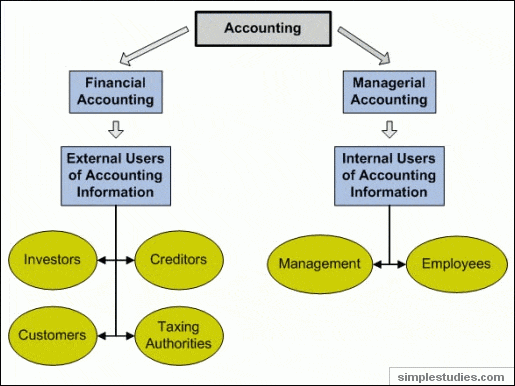
The distinction between Public and private Accounting is that Public is more involved with collecting external financial information's while Private is much inclined with the use of internal information's to aid managers in giving effective decisions.

Questions and Answers About Starting an Accounting Career


An accountant plays a very important role in the functioning and efficiency of a corporation. They provide a number of vital business services to clients including the management of financial matters, auditing, and handling tax issues. However, the specific duties performed in an accounting career will differ depending on what field the practitioner works in, be it public accounting, management accounting, government accounting, or internal auditing.
Accountants will generally use computers and special accounting programs to assist them in their duties. Accountants can summarize and organize data in particular formats to make them more suitable for storage or analysis. The programs also remove a lot of the tedious manual work of accounting out of the job. For this reason, accountants will generally have a very high level of competence with computers and many employers will require them to be proficient in these programs to help keep their work accurate.
The environment in which an accountant works will generally vary depending on what field of accounting he/she is in as well as what type of company or organization he/she works for. The vast majority of accountants work in an office setting, often with many other coworkers and colleagues; although, some accountants are self-employed and may be able to work part of their job at home as well. Most accountants work a standard 40-hour week; though, there are exceptions especially in the case of tax specialists and self-employed accountants who may work longer hours during certain times of the year.
Public accounting firms often send their accountants to their clients' place of work or residence to perform audits. In this scenario, there can also be a lot of traveling involved. Accountants who travel often will most likely use a laptop to allow for the increased mobility of their accounting programs, data, and other information needed on the job.
Accountants, regardless of their chosen field, require a proficiency in mathematics as well as business. Many accountants are unlicensed, especially in the fields of government accounting, management accounting, and internal auditing. A bachelor's degree in accounting or a related field is required to become licensed as a Certified Public Accountant (CPA), Public Accountant (PA), Registered Public Accountant (RPA), or Accounting Practitioner (AP). Some companies will require their accountants to hold master's degrees as well.
There is a large demand for accountants, and as more businesses are created in the coming years, the demand is expected to increase. The rapid expansion of business is also expected to have a large effect on the types of responsibilities accountants will have. Nevertheless, these jobs can be very competitive, and many businesses are increasing their standards by which they hire and the qualifications they demand.
Accountants who have a great knowledge of computers and many different accounting software will have a better change of employment. Also, those who have more education, training, and experience will also have an edge in the job market. It is also important for accountants to demonstrate interpersonal skills as this will also help them perform their job more effectively and get along better with clients.